
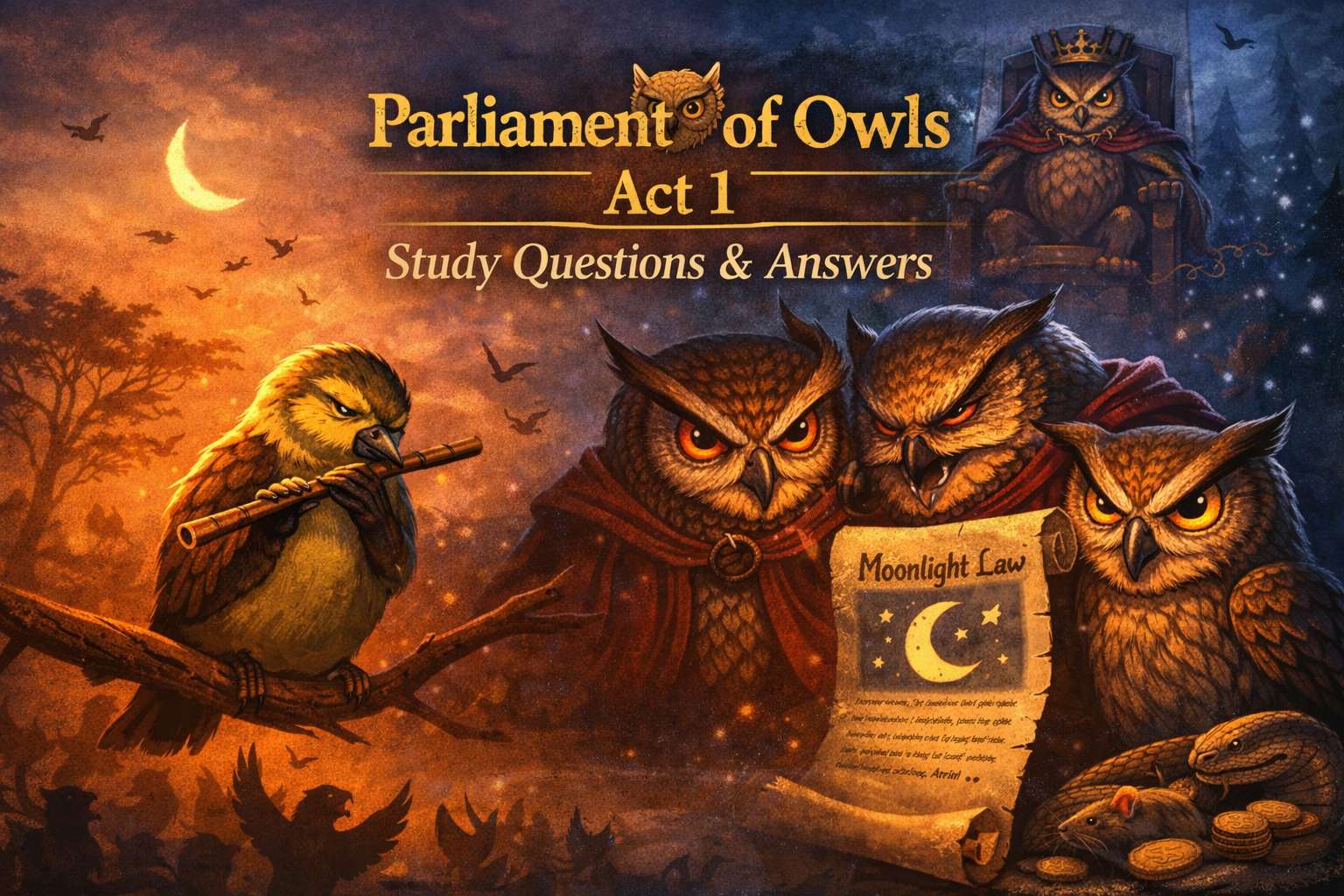
1. Where does the play open and what is the significance of the setting?
Answer:
The play opens at sunset with bird noises and a mournful flute. The setting creates a tense and ominous mood and symbolises the transition from freedom (day) to oppression (night under owl rule).
2. Who is Osogo and why is he playing the flute?
Answer:
Osogo is a weaverbird. He is playing a mournful flute to grieve the death of thirty-three weaverbirds killed by owls during the Weaver Massacre.
3. What does Osogo’s flute symbolise in the play?
Answer:
The flute symbolises mourning, protest, resistance, and the voice of truth that refuses to be silenced despite oppression.
4. How does Osogo challenge the authority of the owls?
Answer:
Osogo questions their hypocrisy, condemns the killing of innocent birds, criticises laws made to favour owls, and insists that every bird has a right to live.
5. Who is Red String and what role does he play?
Answer:
Red String is a powerful owl and advisor to the king. He represents political authority, manipulation, and the enforcement of unjust laws under the guise of order and responsibility.
6. Why does Osogo accuse Red String of hypocrisy
Answer:
Osogo accuses Red String of hypocrisy because owls are expected to appear only at night, yet Red String appears before dark while enforcing strict rules on other birds.
7. What justification does Red String give for owl leadership?
Answer:
Red String claims that owls have superior eyesight, which enables them to protect other birds from dangers such as snakes, and therefore they deserve to rule.
8. Explain the Moonlight Law as introduced in the scene.
Answer:
The Moonlight Law extends the curfew from 10 p.m. to 6 p.m., restricts movement and noise, exempts owls from the law, and introduces a tax allegedly for security purposes.
9. How is religion used as a tool of control in this scene?
Answer:
Red String plans to disguise the tax as a tithe to the gods and present the Moonlight Law as divine will, thereby discouraging opposition and questioning.
10. Who is Tel Tel and why is she conflicted?
Answer:
Tel Tel is a day bird who previously spread propaganda against Osogo on Red String’s orders. She is conflicted because she now realises she was used and has lost the trust of fellow birds.
11. What advice does Arum Tidi give to Red String?
Answer:
Arum Tidi advises that if the birds cannot be convinced, they should be confused—highlighting the use of propaganda and misinformation to control the masses.
12. How does the playwright present abuse of power in this scene?
Answer:
Through unjust killings, selective law enforcement, propaganda, religious manipulation, silencing of dissent, and laws designed to benefit the ruling owls at the expense of other birds.
13. Why is the continued sound of Osogo’s flute at the end significant?
Answer:
It shows that resistance still exists despite intimidation and laws meant to silence opposition, suggesting that oppression cannot completely eliminate dissent.
14. What mood is created at the end of the scene and why?
Answer:
The mood is tense and foreboding because unjust laws are about to be enforced, resistance is brewing, and the conflict between rulers and the ruled remains unresolve